
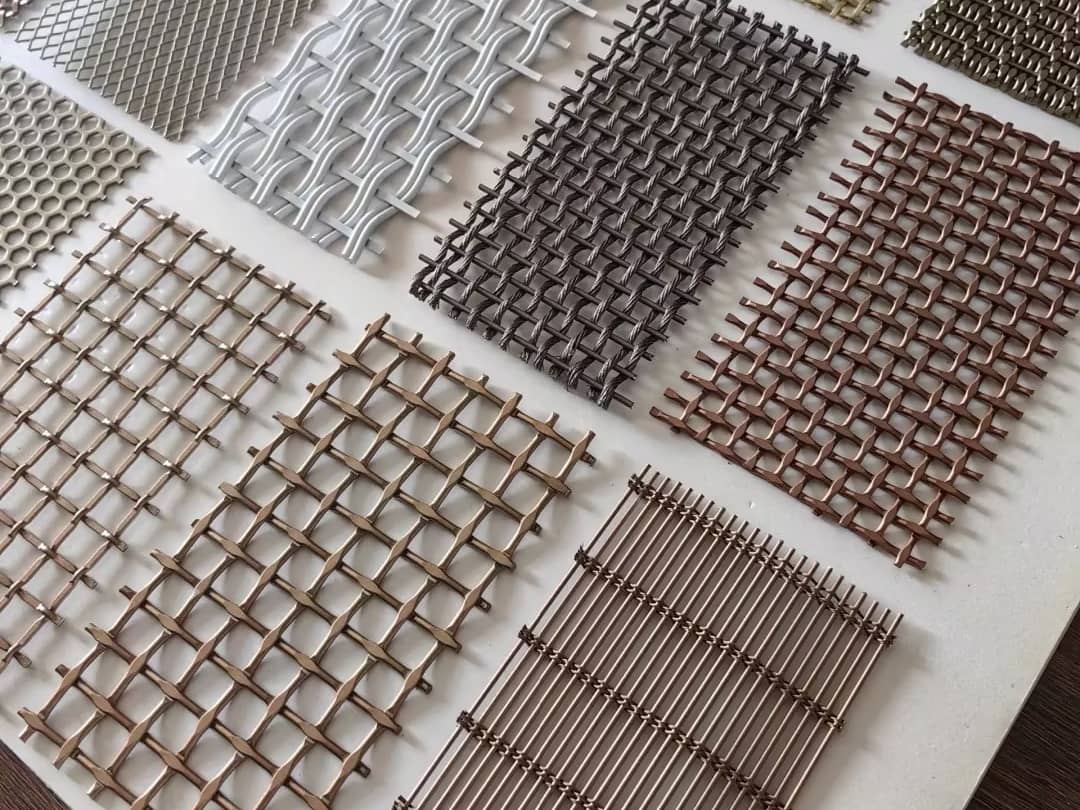
- How Do Woven And Welded Wire Mesh Sheets Differ In Manufacturing?
- What Makes Decorative Metal Mesh Different in Visual Appeal?
- How Should You Choose Between Woven and Welded Wire Mesh Sheets for Different Applications?
- What Factors Matter When Selecting the Right Stainless Steel Wire Mesh for Your Project?
- Frequently Asked Questions
- Conclusion
When you're picking between woven and welded wire mesh, the main difference boils down to how they're made. Woven mesh uses interlaced wires that create flexible, decorative patterns—think of it like weaving fabric. Welded mesh, on the other hand, joins wires at their crossing points with spot welds, making a rigid grid. This affects everything from how your decorative metal mesh looks to how well it holds up in different settings.
How Do Woven And Welded Wire Mesh Sheets Differ In Manufacturing?
The way these two types of wire mesh sheets get made really sets them apart. Let's break down what makes each one unique.
Manufacturing Process Comparison
| Comparison Factor | Woven Mesh | Welded Mesh |
|---|---|---|
| Core Technology | Interlacing: warp and weft wires weave through each other | Spot welding: resistance welding at intersection points |
| Process Characteristics | High flexibility creates complex patterns | Strong rigidity, structural stability |
| Stainless Steel Wire Mesh Processing | Requires precision looms, complex procedures | Automated welding equipment, higher efficiency |
| Aperture Precision | Can show small variations in opening size | Stable dimensions with fixed weld points |
| Production Speed | Slower, better for custom work | Fast batch production |
| Material Efficiency | Higher efficiency, minimal waste | Requires cutting, some material loss |
From a quality standpoint, both methods produce reliable stainless steel wire mesh when done right. Woven mesh might shift slightly under tension, so the opening sizes can vary within normal manufacturing tolerances rather than staying perfectly identical. Welded mesh stays put—once those weld points cool, you've got fixed dimensions that won't budge.
What Makes Decorative Metal Mesh Different in Visual Appeal?
This is where things get interesting for architects and designers. The aesthetic possibilities vary wildly between these two options.
Visual Characteristics of Architectural Woven Metal Mesh
Woven mesh shines when you want movement and texture. Because the wires aren't locked in place, they can create a fabric-like drape that catches light at different angles throughout the day. You'll see this used in building facades where architects want that shimmer effect—the Kauffman Center for the Performing Arts in Kansas City uses woven stainless steel wire mesh that literally glows at sunset.
The weaving process lets you play with wire thickness and spacing to create depth. Some manufacturers can weave in colored wires or use different metals in the same panel, giving you patterns that welded mesh just can't match.
Geometric Aesthetics of Welded Wire Mesh Sheet
Welded mesh has a clean, industrial look—think modern minimalist. The grid pattern is precise and uniform, which works great for contemporary architecture. The weld points create small bumps at each intersection, adding a subtle texture that's less fluid than woven patterns but more structured.
Surface Treatment and Visual Texture Variations
Both types can get surface treatments like powder coating or electropolishing. But here's the thing: these finishes look different on each mesh type. On woven decorative metal mesh, treatments tend to pool slightly in the weave gaps, creating shadow effects. On welded panels, you get an even coat that emphasizes the geometric grid.
Customization Design Possibilities
Woven mesh wins on customization. You can adjust the weave pattern mid-production to create gradients or custom shapes. Welded mesh is more limited—you're working with a fixed grid, though you can vary wire thickness and spacing between production runs.
If you're designing something unique, architectural woven metal mesh gives you more creative control. For standardized applications where consistency matters most, the welded wire mesh sheet delivers predictable results every time.
How Should You Choose Between Woven and Welded Wire Mesh Sheets for Different Applications?
The right choice depends on what you're actually building or installing. Let's look at where each type really performs.
Architectural Facade and Decorative Metal Mesh Uses
For building exteriors, woven mesh is the go-to for decorative metal mesh applications. It handles thermal expansion better—buildings breathe as temperatures change, and woven panels can flex slightly without damage. Major projects like airport terminals often specify architectural woven metal mesh because it combines visual impact with durability.
In practice, many architects partner with us, ANSUS METAL, to turn facade concepts into complete systems, including mesh selection, framing details, and mounting hardware that all work together on site.
Structural Support and Security Requirements
Need something that won't budge? Welded wire mesh sheet is your answer. Fencing, security barriers, and concrete reinforcement all use welded mesh because those fixed joints create serious strength. A heavy-gauge welded panel (for example, using wire around 4–6 mm in diameter) can support loads that would deform woven mesh.
Filtration, Screening, and Industrial Applications
Industrial settings split the difference. Fine filtration needs woven stainless steel wire mesh—the flexible structure traps particles better and cleans out more easily. But for conveyor systems or machine guards, welded mesh holds its shape under constant vibration and impact.
Creative Installation in Art Projects
Artists love woven mesh for sculptures and installations because you can shape it into curves and organic forms. Welded panels work better for geometric art pieces where you want sharp angles and stability.
What Factors Matter When Selecting the Right Stainless Steel Wire Mesh for Your Project?
Making the final call comes down to matching mesh properties to your specific needs. Here's what actually matters in real-world applications.
Performance Requirements and Functional Matching
Start with the basics: Does your wire mesh sheet need to move or stay rigid? Ceiling installations often need woven mesh for flexibility during installation. Floor grating demands welded mesh for load-bearing strength. Don't overthink it—match the mesh type to the mechanical requirements first, then worry about aesthetics.
Budget Analysis and Cost-Effectiveness
Actual pricing depends heavily on material grade, mesh specification, and labor, and either woven or welded mesh can be more economical depending on the project setup. Welded mesh often benefits from efficient automated production on standard patterns, while custom decorative woven meshes can become more expensive as designs get complex. Factor in installation costs too—woven panels sometimes need more labor to tension properly, while welded sheets might require reinforcement framing.
Installation and Maintenance Considerations
Woven architectural woven metal mesh is lighter and easier to maneuver on-site, but you'll need proper tensioning hardware. Welded stainless steel wire mesh ships in rigid panels that need sturdy mounting points, but install faster once you've got the framework up.
Maintenance-wise, both clean up well with standard methods. Woven mesh can trap debris in the weave intersections, so you might need periodic pressure washing or similar cleaning for outdoor installations.
Environmental Durability Requirements
Both mesh types handle weather well when made from 304 or 316 stainless steel. Coastal areas or chemical plants should specify 316-grade stainless steel wire mesh regardless of construction method—the molybdenum content fights corrosion better. Woven mesh performs slightly better in high-vibration environments because it can absorb movement without stress cracks forming at weld points.
Frequently Asked Questions
Q1. Can You Combine Woven and Welded Techniques in One Decorative Metal Mesh Panel?
You generally can't combine both techniques in a single panel during manufacturing, but architects sometimes layer them for visual effect. Some specialty manufacturers create hybrid products where they weld reinforcement bars to the edges of woven stainless steel wire mesh panels—this gives you the decorative flexibility of weaving with the structural stability of welded borders. It's more expensive and requires custom ordering, but it solves the problem when you need both characteristics in architectural woven metal mesh applications.
Q2. Which Wire Mesh Sheet Type Requires Less Maintenance Over a 20-Year Lifespan?
Welded mesh needs occasional inspection of weld points—outdoor exposure can cause corrosion to start at these connection spots if the protective coating breaks down. Woven decorative metal mesh requires checking for wire loosening, especially in high-wind areas where the flexibility can work against you over time. For true low-maintenance performance, choose 316 stainless steel wire mesh in either style and apply a quality protective finish—that combination can remain serviceable for several decades in typical architectural and industrial environments with just periodic cleaning.
Q3. How Wire Thickness Affects Woven vs. Welded Mesh Choice?
Wire thickness plays a bigger role than most people realize. Woven mesh works best with thinner wires (often in the range of about 0.5–2.0 mm for many coarse and architectural meshes, with some designs using cables up to roughly 3 mm) because thicker wires don't bend easily through the weaving process—you lose that characteristic flexibility that makes architectural woven metal mesh attractive. Welded wire mesh sheet handles heavier gauges better (such as 4–6 mm and beyond in reinforcing and heavy-duty panels) since you're not bending the wire, just joining straight pieces. If your decorative metal mesh project requires structural strength from thick wires, welding is usually the only practical option.
Conclusion
Ready to specify the right mesh for your project? Start by identifying whether you need flexibility or rigidity—that single decision will point you toward woven or welded options. Then match your aesthetic vision and budget to the manufacturing method that delivers it. When in doubt, request samples of both architectural woven metal mesh and welded alternatives in your chosen stainless steel grade. Contact experienced suppliers who can walk through load calculations and help you avoid costly mistakes.
If you want a real-world reference, we at ANSUS METAL offer woven, welded, perforated, and decorative metal mesh systems plus technical support, so you can move from initial concept to a buildable, code-compliant specification with fewer surprises on site.
Share:
2025 Design Trends – Wire Mesh for Railings
The Process of Making Perforated Metal