
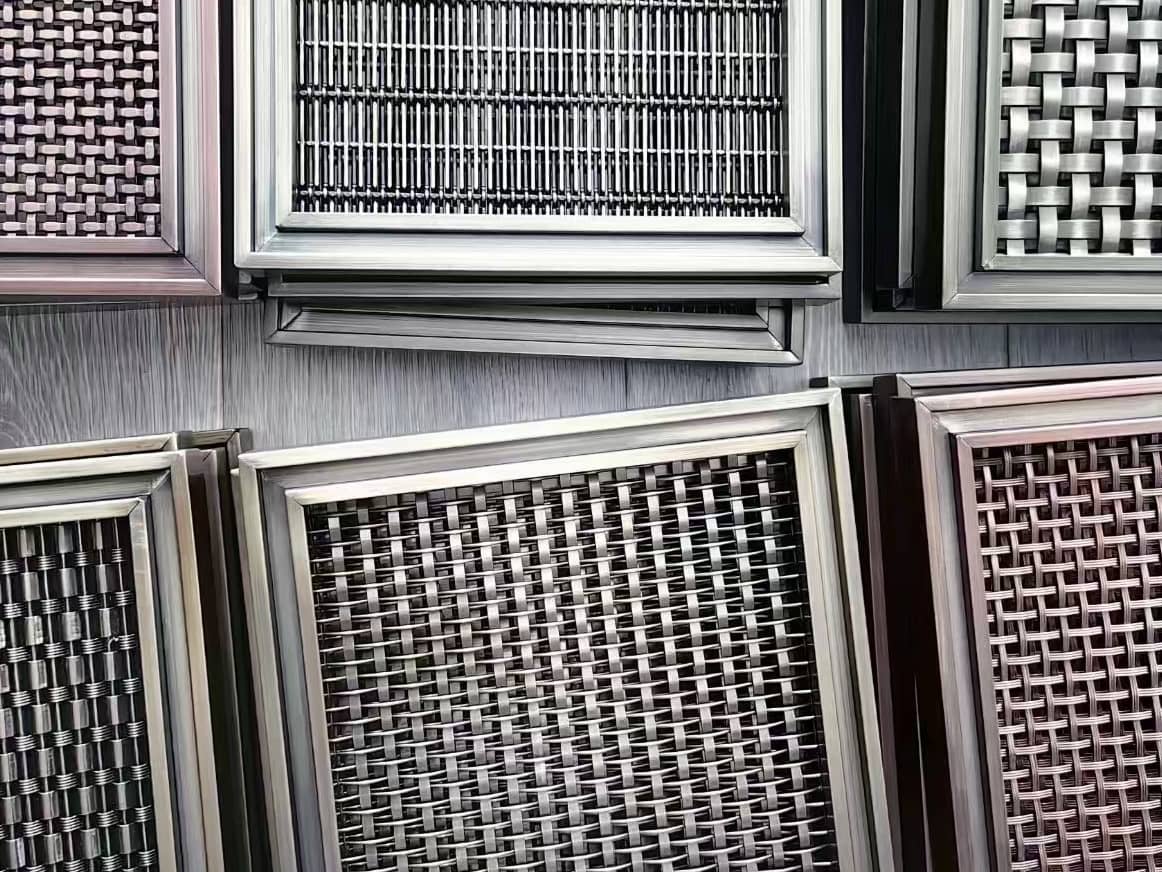
Choosing between woven and welded wire mesh sheets comes down to what you need them for. Woven mesh gives you flexibility and works great for fine filtering, while welded mesh brings serious strength to the table. Both types come in stainless steel wire mesh options, and each has its place—from architectural woven metal mesh on building facades to heavy-duty industrial barriers. Let's break down which one fits your project best.
How Do Woven and Welded Wire Mesh Sheets Compare?
When you're standing in front of two wire mesh sheet options, they might look similar at first glance. But the differences matter—a lot. Understanding these distinctions will save you money, time, and headaches down the road.
What Woven Wire Mesh Sheets Are Made Of
Woven mesh is exactly what it sounds like. Manufacturers weave individual metal wires together, just like fabric. The wires go over and under each other in patterns—plain weave, twill weave, or Dutch weave being the most common. This creates a flexible sheet that bends and conforms to different shapes. Stainless steel wire mesh in woven form is popular because it won't rust and holds up outdoors.
The weaving happens on specialized looms that interlock wires at each intersection. No welding, no gluing—just pure mechanical interlocking. This means every wire can move slightly, giving the mesh that characteristic flexibility.
What Welded Wire Mesh Sheets Are All About
Welded mesh takes a different approach. Wires run perpendicular to each other and get welded at every intersection point. Picture a grid where each crossing point is permanently fused. This creates a rigid, stable wire mesh sheet that doesn't flex much.
The welding process uses electrical resistance to heat the intersection points until the metal fuses. Modern automated machines produce large panels quickly, which is why welded mesh often costs less for big projects. Stainless steel wire mesh in welded form gives you that same corrosion resistance but with added structural strength.
Core Differences and Key Advantages
| Feature | Woven Wire Mesh | Welded Wire Mesh |
| Construction Method | Interlocked wires (no joints) | Welded at intersections |
| Flexibility | High - bends easily around curves | Low - stays rigid |
| Strength | Moderate | High structural strength |
| Mesh Opening Accuracy | Typically controlled by ISO tolerances (for many sizes, the mean aperture tolerance is around ±5–11%, depending on opening and material) | Typically controlled by welded-mesh tolerances (often a few percent on opening size, depending on the standard and opening range) |
| Price Range | Higher per sq ft | Often lower for large volumes |
| Installation | Needs careful handling | Easier - stays flat and square |
| Best Applications | Architectural woven metal mesh, precise filtration, decorative elements | Security fencing, concrete reinforcement, heavy-duty guards |
| Aesthetic Quality | Smoother visual appearance | Grid pattern with visible welds |
| Vibration Resistance | Excellent - no joints to crack | Moderate - joints may stress |
| Temperature Performance | Handles thermal expansion well | Can develop a stress point |
The tolerances come from industry manufacturing standards—woven mesh achieves tighter tolerances because there's no heat distortion from welding. Welded mesh typically handles higher loads (confirm with supplier load tables for your specific wire size and opening), while woven mesh wins on longevity in high-vibration environments. Both types of stainless steel wire mesh resist corrosion equally well—that's about the material, not the construction method.
Where Should You Use Woven Wire Mesh Sheets?
Woven mesh shines in specific scenarios. Let's look at where it makes the most sense.
Architectural Woven Metal Mesh for Buildings
Modern architecture loves woven mesh. You'll find architectural woven metal mesh on building exteriors as sunscreens, on parking garage facades for ventilation, and as decorative interior partitions. The Guthrie Theater in Minneapolis uses architectural woven metal mesh on its exterior—it creates visual interest while allowing airflow.
Industrial Filtering and Screening
Manufacturing plants use woven stainless steel wire mesh for everything from food processing to chemical filtration. The tight, uniform openings trap particles consistently. Oil refineries rely on it, and water treatment facilities use it for screening debris.
Decorative Interior Elements
Restaurants, hotels, and upscale offices use woven wire mesh sheets as design features—think room dividers, light fixtures, or wall panels. The material adds an industrial-chic vibe while staying functional.
Fine Particle Separation
Laboratories and pharmaceutical companies need precise separation. Woven mesh with openings measured in microns filters out exact particle sizes, which matters when you're producing medicine or conducting research.
What Projects Need Welded Wire Mesh Sheets?
Welded mesh tackles the heavy-duty jobs where strength comes first.
Security Fencing and Barriers
Commercial properties, industrial sites, and even residential yards use welded wire mesh sheets for fencing. The rigid grid resists cutting and climbing better than woven alternatives. Airport perimeter fences almost always use welded mesh.
Concrete Reinforcement Applications
Construction crews lay welded stainless steel wire mesh into concrete slabs before pouring. It prevents cracking and adds tensile strength—you'll find it in driveways, warehouse floors, and bridge decks. Standard sizes like 6x6-inch grid patterns are industry norms here.
Animal Enclosures and Agricultural Uses
Farms, zoos, and kennels prefer welded mesh because animals can't push through the rigid structure. The openings stay consistent even under pressure, and the panels mount quickly to posts or frames.
Heavy-Duty Industrial Guards
Machine guards, conveyor belt covers, and equipment barriers use welded wire mesh sheets. OSHA regulations often specify mesh size and strength requirements—welded mesh meets these specs reliably.
How Do You Pick the Right Stainless Steel Wire Mesh Type?
Making the choice doesn't have to be complicated. Work through these key questions.
Project Needs Assessment
Start simple: Does your wire mesh sheet need to bend, or stay flat? Will it filter something, or just block access? Is appearance critical, or purely functional? Answering these narrows your options fast.
Consider the load it'll carry. Welded mesh handles heavier loads without sagging. But if you need the mesh to conform to a curved surface, woven is your only real option.
Budget Considerations
Get quotes for both types in your required size. For orders of large-area quantities, welded mesh usually costs less. Smaller custom projects might see closer pricing, especially for stainless steel wire mesh, where material cost dominates.
Environment and Maintenance
Both stainless steel wire mesh types resist corrosion, but think about your specific conditions. High-vibration environments (near machinery or roads) favor woven mesh since there are no welded joints to fail. Coastal areas do fine with either type in 316-grade stainless.
Cleaning matters for architectural woven metal mesh. The smoother surface of woven mesh sheds dirt more easily than welded mesh with its raised weld points.
Load and Durability Requirements
Check engineering specs if you have them. Welded mesh typically handles higher loads than equivalent woven mesh. For structural applications, this isn't negotiable—you need welded.
But for lifespan in flexing applications, woven mesh outlasts welded. Think of it like this: welding creates stress points, weaving doesn't.
Supplier Selection
Work with suppliers who stock both types and can explain the tradeoffs honestly. Ask for samples—handling the actual material tells you more than any spec sheet. Good suppliers should help you calculate exact quantities and suggest the right wire gauge for your application.
If your project is design-forward (hotels, offices, residential partitions), Ansus Metal’s Decorative Screen lineup is a concrete example you can reference when asking for material options, fabrication formats (laser-cut/perforated/expanded), and finish choices.
FAQs
Q1. Can I Use the Same Wire Mesh Sheet for Indoor and Outdoor Projects?
Yes, but the material is the most important factor. For any outdoor project, stainless steel wire mesh (both woven and welded) is the ideal choice due to its excellent rust and corrosion resistance. We recommend 304-grade for most applications and upgrading to 316-grade for coastal or highly corrosive environments.
Q2. Does Architectural Woven Metal Mesh Require Special Installation Tools?
It's less about special tools and more about the right technique. The mesh must be installed within a perimeter frame and pulled taut with tensioning tools, not screwed directly to a surface. For a clean cut on the stainless steel, simply use aviation snips.
Q3. How Long Do Different Wire Mesh Sheets Actually Last?
The material is the biggest factor. A stainless steel mesh, whether woven or welded, can easily last for decades. The difference in construction method really only matters under specific stress: woven mesh handles vibration better because it flexes, while the rigid joints of welded mesh can become weak points over time.
Conclusion
Your choice between woven and welded wire mesh sheets boils down to priorities. Need flexibility and precision? Go woven. Want strength and value on large projects? Pick welded. Both work great in stainless steel wire mesh for long-term durability.
If you’re collecting quotes for facade, ceiling, railing, or screen applications, Ansus Metal is one option to contact with your spec (opening size, wire gauge, finish, and mounting approach) to speed up selection.
Share:
What are the Different Types of Expanded Metal?
Cabinet Door Metal Mesh: Complete Guide